
How Big Are Beatrix Potter's Animals?
Brief notes on an obsession

Next month is the 160th anniversary of Beatrix Potter’s birth, so we can expect all sorts of celebratory shenanigans. Quite right too. There’s a lot to celebrate about Beatrix Potter.
She invented tie-in merch, for a start — licensing a Peter Rabbit plushie in 1903. She was completely brilliant at sound effects. A magpie says: ‘Gammon? ha! HA!’ Spinach? ha! HA!’, songbirds say, ‘Who’s bin digging up my nuts? Who’s-bin digging-up-my-nuts?’ or ‘Little bit-a-bread and-no-cheese! Little bit-a-bread an’-no-cheese!’, and a bumblebee says: ‘Zizz, Bizz, Bizzz!’ and ‘Zizz, Wizz, Wizz!’ Plus — always a good move for a children’s author — she told Walt Disney to f*** off.
But the question that obsesses me about the OG Potterverse (Beatrix had one before J K Rowling was thought of) is this: how big are these talking animals? Also, relatedly: how animaly are these talking animals?
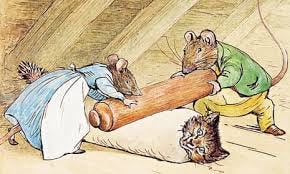
The ground zero for my obsession is, as it is with many Potterphiles, the traumatic experience of reading her claustrophobia-inducing cannibal1 horror novel The Tale of Samuel Whiskers: Or, the Roly-Poly Pudding. As you may remember, the plot concerns Tom Kitten, who finds his way into the crawlspace beneath the attic floor where he’s held prisoner by the titular Samuel Whiskers, a large and greedy rat, who encourages his wife to turn the kitten into a roly-poly pudding2. She gets quite far through the process — there’s a shudder-making image of the kitten rolled in dough, helpless, just his head poking out the top, while the horror-rats3 smooth him over with a rolling-pin — before he is rescued by a saw-wielding terrier, John Joiner, and the rats are sent packing.
But it’s the coda that sticks with me, at least in waking life. In one of her deftly metafictional touches, Beatrix Potter enters the story. She is on her way to the post-office, apparently oblivious of the horror that has recently unfolded, and meets Mr and Mrs Whiskers legging it in the opposite direction. She tells us that John Joiner recently built her a wheelbarrow on commission (she’s a good customer to this carpenter despite his lacking opposable thumbs: a brace of hen-coops are next). And here are the two rats making their escape ‘with big bundles on a little wheelbarrow, which looked very like mine’. She adds: ‘I am sure I never gave her leave to borrow my wheelbarrow.’
Never mind the breach of good manners that she’s so ventilated about. How big is this fricking wheelbarrow? If it’s small enough for a rat to push, it’s not going to be much use to an ordinary-size human like Beatrix Potter. (I’ve seen photographs: she was definitely bigger than the average rat.) But if it’s big enough for Beatrix Potter to use, HOW BIG IS SAMUEL WHISKERS? And immediately, we’re back to the fear that he and his Rose West of a wife could turn any of us into roly-poly puddings.
A related data-point is to be found in the closing pages of The Tale of Mrs Tiggy-Winkle. The community-minded Mrs Tiggy-Winkle, you’ll remember, spends much of the story doing the laundry — including the apparently mislaid handkerchiefs of the book’s human protagonist. It’s all very confusing, but there’s no indication that, for instance, Mrs Tiggy-Winkle is somehow ironing handkerchiefs the size of bedsheets. And at the end of the story — leaving the nicely pressed hankies as a parting gift — she transforms:
And how small she had grown – and how brown – and covered with PRICKLES! Why! Mrs Tiggy-winkle was nothing but a HEDGEHOG.
She grows smaller. Was she approximately human-sized in her wearing-a-pinny-and-doing-the-laundry phase, but then hedgehog-sized at the end? In the final image, she is a completely naturalistic hedgehog4. She looks like a little brown aubergine. So it’s possible that at the end of his story — shudder — Samuel Whiskers has grown bigger.
Also, the question of what these animals eat enters the issue — is it the usual diet you’d expect of their species, or something more like what Beatrix Potter would eat? These rats, for instance, are into their nursery puddings: the Whiskers clan are more particular than most rats. And another predator, the fox, might be expected to want to eat the idiotic Jemima Puddle-Duck5: foxes eat ducks all the time, when they can catch them. But he sends her off to get him some sage and onion first, which is much more in the human line. Tommy Brock, the badger in The Tale of Mr Tod, likes “wasps nests and frogs and worms” but is also partial to rabbit pie. Pig Robinson eats bread and jam sandwiches6. Rabbits, in Potter, are very keen on lettuce — but they also drink chamomile tea. And that’s to say nothing of the shop in The Tale of Ginger and Pickles, where a tomcat and a fox-terrier sell snuff to (heavily leveraged) mice.
I should add that these are not considerations unique to Beatrix Potter. In The Wind in the Willoows, for instance, we can sort-of-assume that Toad and the gang are approximately human-sized. Toad steals a (human) washerwoman’s clothes when he escapes from jail. His caravan (before he gets into motor cars) is pulled along by a horse. But, conversely, that very caravan also contains a caged songbird; ham and eggs are to be found in Badger’s pantry; Mole eats sardines; and Ratty’s picnic contains cold roast beef and tongue.
This implies that alongside human-sized toads and badgers, in Kenneth Grahame’s universe, there are to be found normal-sized pigs (which badgers are blithely likely to butcher and eat), cows (which rats eat), fish (which moles eat), chickens and songbirds. If we pull focus from the riverbank, in other words, this universe is much less cosy and much more bizarre than at first glance.
Me, I blame all the size-shifting in Alice’s Adventures in Wonderland. Children’s writers have been cooked, as far as scale goes, from right at the start of the modern tradition.
***
I’ve had a busy week. It started at the Lake District Book Festival, brilliantly organised by Chris de Bellaigue, where I pimped my book about children’s writing (are you interested in children’s writing, Sam? I don’t think you mentioned it. Why, as it happens…) and interviewed Sebastian Faulks.
Then I recorded two podcasts — Simon Sebag-Montefiore and Carlo Rovelli; will post them both here when they’re up — before going off to chair Robert Macfarlane about his new Book of Birds. Not being a birdy person, I was on thin ice. I just about redeemed myself by being able to tell a moorhen from a coot (okay, it’s a coinflip), but embarrassed myself by thinking it was starlings or sparrows that pinched milk from milk bottles. It’s blue-tits. Rob sent me this fascinating paper about the blue-tit milk bottle thing afterwards.
And — Christ! — I was then two hours late for the first in-person judging meeting of the Baillie Gifford Prize, because I’m an idiot. But we caught up. Got a lot of nonfiction to read over the next few months.
***
***
And this week’s podcast was with the great Frank Cottrell-Boyce on his new book A British Childhood. I’m very happy to say Frank has agreed to review a forthcoming book about Paddington Bear for me, which I’ll link to in due course. No better critic for it, IMO.
It’s not technically cannibalism, aka intra-species din-dins: the rat wants to eat a cat. But it has, since all these creatures are at some level stand-in humans, or humans in animal drag, a definite cannibal vibe. If you’re seven or eight, the whole set up is deeply unsettling. I’d much rather have watched The Hills Have Eyes and been done with it.
Beatrix Potter hails from the era of Mrs Beeton, when puddings were proper.
You can bet this was a source text for James Herbert.
Beatrix Potter was a very skilled amateur naturalist and painter from nature. She submitted a scholarly paper on mycology to the Linnaean Society, based on her drawings of fungal spores. Anthropomorphism was only one half of her schtick.
We’re supposed to find her cute, but she really is an idiot. She half deserves to be eaten.
A normal pig, true, would eat bread-and-jam sandwiches. A pig will eat anything. But it wouldn’t normally be given bread-and-jam sandwiches for its packed lunch.
? ha! HA!’, songbirds say, ‘Who’s bin digging up my nuts? Who’s-bin digging-up-my-nuts?’ or ‘Little bit-a-bread and-no-cheese! Little bit-a-bread an’-no-cheese!’, and a bumblebee says: ‘Zizz, Bizz, Bizzz!’ and ‘Zizz, Wizz, Wizz!’ Plus — always a good move for a children’s author — she told Walt Disney to f*** off.
But the question that obsesses me about the OG Potterverse (Beatrix had one before J K Rowling was thought of) is this: how big are these talking animals? Also, relatedly: how animaly are these talking animals?
The ground zero for my obsession is, as it is with many Potterphiles, the traumatic experience of reading her claustrophobia-inducing cannibal1 horror novel The Tale of Samuel Whiskers: Or, the Roly-Poly Pudding. As you may remember, the plot concerns Tom Kitten, who finds his way into the crawlspace beneath the attic floor where he’s held prisoner by the titular Samuel Whiskers, a large and greedy rat, who encourages his wife to turn the kitten into a roly-poly pudding2. She gets quite far through the process — there’s a shudder-making image of the kitten rolled in dough, helpless, just his head poking out the top, while the horror-rats3 smooth him over with a rolling-pin — before he is rescued by a saw-wielding terrier, John Joiner, and the rats are sent packing.
But it’s the coda that sticks with me, at least in waking life. In one of her deftly metafictional touches, Beatrix Potter enters the story. She is on her way to the post-office, apparently oblivious of the horror that has recently unfolded, and meets Mr and Mrs Whiskers legging it in the opposite direction. She tells us that John Joiner recently built her a wheelbarrow on commission (she’s a good customer to this carpenter despite his lacking opposable thumbs: a brace of hen-coops are next). And here are the two rats making their escape ‘with big bundles on a little wheelbarrow, which looked very like mine’. She adds: ‘I am sure I never gave her leave to borrow my wheelbarrow.’
Never mind the breach of good manners that she’s so ventilated about. How big is this fricking wheelbarrow? If it’s small enough for a rat to push, it’s not going to be much use to an ordinary-size human like Beatrix Potter. (I’ve seen photographs: she was definitely bigger than the average rat.) But if it’s big enough for Beatrix Potter to use, HOW BIG IS SAMUEL WHISKERS? And immediately, we’re back to the fear that he and his Rose West of a wife could turn any of us into roly-poly puddings.
A related data-point is to be found in the closing pages of The Tale of Mrs Tiggy-Winkle. The community-minded Mrs Tiggy-Winkle, you’ll remember, spends much of the story doing the laundry — including the apparently mislaid handkerchiefs of the book’s human protagonist. It’s all very confusing, but there’s no indication that, for instance, Mrs Tiggy-Winkle is somehow ironing handkerchiefs the size of bedsheets. And at the end of the story — leaving the nicely pressed hankies as a parting gift — she transforms:
And how small she had grown – and how brown – and covered with PRICKLES! Why! Mrs Tiggy-winkle was nothing but a HEDGEHOG.
She grows smaller. Was she approximately human-sized in her wearing-a-pinny-and-doing-the-laundry phase, but then hedgehog-sized at the end? In the final image, she is a completely naturalistic hedgehog4. She looks like a little brown aubergine. So it’s possible that at the end of his story — shudder — Samuel Whiskers has grown bigger.
Also, the question of what these animals eat enters the issue — is it the usual diet you’d expect of their species, or something more like what Beatrix Potter would eat? These rats, for instance, are into their nursery puddings: the Whiskers clan are more particular than most rats. And another predator, the fox, might be expected to want to eat the idiotic Jemima Puddle-Duck5: foxes eat ducks all the time, when they can catch them. But he sends her off to get him some sage and onion first, which is much more in the human line. Tommy Brock, the badger in The Tale of Mr Tod, likes “wasps nests and frogs and worms” but is also partial to rabbit pie. Pig Robinson eats bread and jam sandwiches6. Rabbits, in Potter, are very keen on lettuce — but they also drink chamomile tea. And that’s to say nothing of the shop in The Tale of Ginger and Pickles, where a tomcat and a fox-terrier sell snuff to (heavily leveraged) mice.
I should add that these are not considerations unique to Beatrix Potter. In The Wind in the Willoows, for instance, we can sort-of-assume that Toad and the gang are approximately human-sized. Toad steals a (human) washerwoman’s clothes when he escapes from jail. His caravan (before he gets into motor cars) is pulled along by a horse. But, conversely, that very caravan also contains a caged songbird; ham and eggs are to be found in Badger’s pantry; Mole eats sardines; and Ratty’s picnic contains cold roast beef and tongue.
This implies that alongside human-sized toads and badgers, in Kenneth Grahame’s universe, there are to be found normal-sized pigs (which badgers are blithely likely to butcher and eat), cows (which rats eat), fish (which moles eat), chickens and songbirds. If we pull focus from the riverbank, in other words, this universe is much less cosy and much more bizarre than at first glance.
Me, I blame all the size-shifting in Alice’s Adventures in Wonderland. Children’s writers have been cooked, as far as scale goes, from right at the start of the modern tradition.
***
I’ve had a busy week. It started at the Lake District Book Festival, brilliantly organised by Chris de Bellaigue, where I pimped my book about children’s writing (are you interested in children’s writing, Sam? I don’t think you mentioned it. Why, as it happens…) and interviewed Sebastian Faulks.
Then I recorded two podcasts — Simon Sebag-Montefiore and Carlo Rovelli; will post them both here when they’re up — before going off to chair Robert Macfarlane about his new Book of Birds. Not being a birdy person, I was on thin ice. I just about redeemed myself by being able to tell a moorhen from a coot (okay, it’s a coinflip), but embarrassed myself by thinking it was starlings or sparrows that pinched milk from milk bottles. It’s blue-tits. Rob sent me this fascinating paper about the blue-tit milk bottle thing afterwards.
And — Christ! — I was then two hours late for the first in-person judging meeting of the Baillie Gifford Prize, because I’m an idiot. But we caught up. Got a lot of nonfiction to read over the next few months.
***
***
And this week’s podcast was with the great Frank Cottrell-Boyce on his new book A British Childhood. I’m very happy to say Frank has agreed to review a forthcoming book about Paddington Bear for me, which I’ll link to in due course. No better critic for it, IMO.
It’s not technically cannibalism, aka intra-species din-dins: the rat wants to eat a cat. But it has, since all these creatures are at some level stand-in humans, or humans in animal drag, a definite cannibal vibe. If you’re seven or eight, the whole set up is deeply unsettling. I’d much rather have watched The Hills Have Eyes and been done with it.
Beatrix Potter hails from the era of Mrs Beeton, when puddings were proper.
You can bet this was a source text for James Herbert.
Beatrix Potter was a very skilled amateur naturalist and painter from nature. She submitted a scholarly paper on mycology to the Linnaean Society, based on her drawings of fungal spores. Anthropomorphism was only one half of her schtick.
We’re supposed to find her cute, but she really is an idiot. She half deserves to be eaten.
A normal pig, true, would eat bread-and-jam sandwiches. A pig will eat anything. But it wouldn’t normally be given bread-and-jam sandwiches for its packed lunch.
Delightful! (The absence of female animals in Wind in the Willows is another point of concern.) I’ve just finished reading The Blizzard by Vladimir Sorokin, set in a kind of alt Russia similarly haunted by problems of scale. The are horses the size of mice but also occasionally horses the size of ships - and humans are similarly prone to these slippages of proportion. There’s something about it that makes perfect intuitive sense in Russia context. But also maybe a childhood imaginative context - these things are both animals and proxy humans at the same time and so why wouldn’t they be hedgehog sized and human sized at the same time?
In terms of Merch, I also love that she used an illustration of her very own fireplace at Hill Top in The Tale of Samuel Whiskers so that (I like to think) a hundred years later coachloads of tourists could flock to Hill Top to see the original. Now that is forward thinking!