
Polytropos
Mything the point

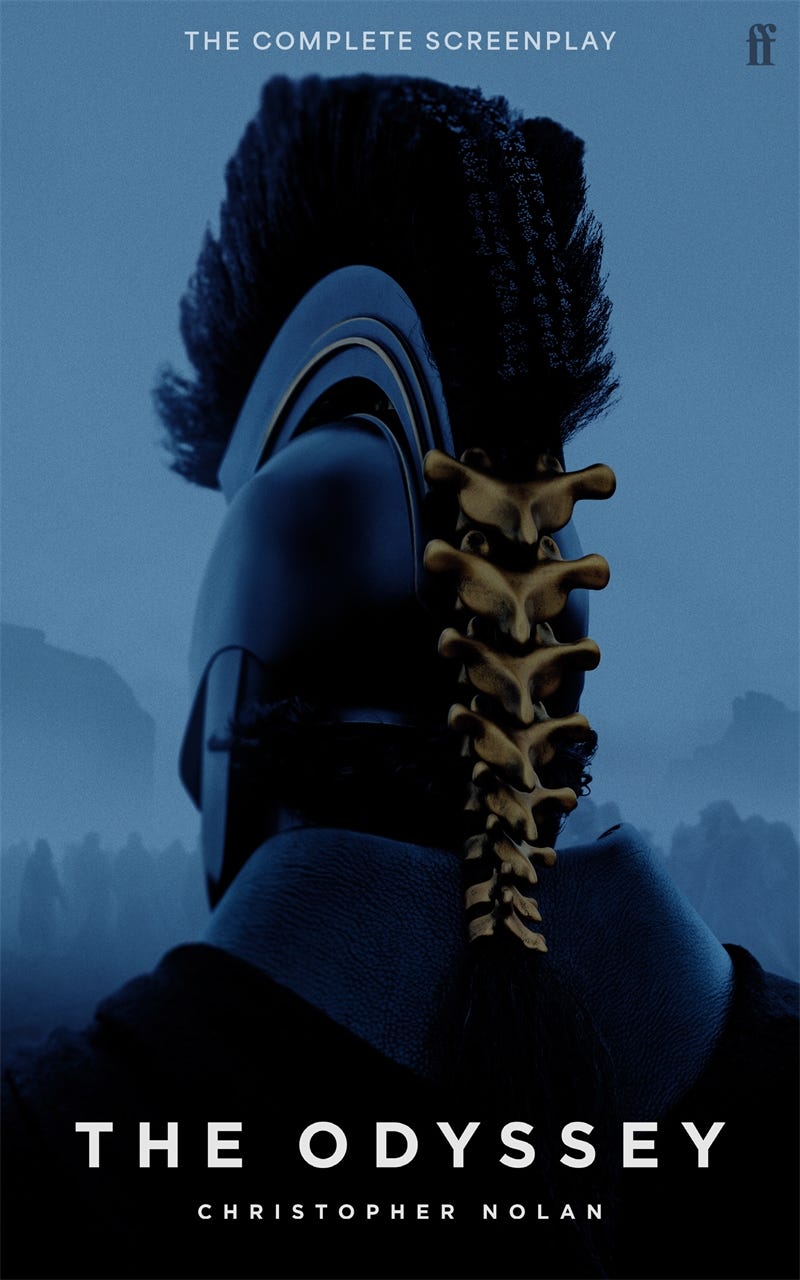
Like everyone, it seems, I’ve been thinking a bit about the Odyssey this week. I wrote my Spectator column on the subject, but since it’s paywalled — and since I had the unusual experience of continuing to think about it after writing my column, I thought I’d expand on the topic a bit here.
It strikes me that though it superficially resembles it, the culture-wars stooshio over the Nolan movie is slightly different from the bog-standard row over colourblind casting. In the first place, a lot of people who probably haven’t read the Odyssey, and certainly haven’t read it in Greek, are invested in the idea of its importance. It’s a totem. Yes, these same people will lose their shit over a black Hermione in Harry Potter. No doubt there’s the odd person who’ll lose their shit if you make a film of The Portrait of a Lady with a black Isabel Archer. But they’ll lose their shit in a measurably more pompous way over a black Helen of Troy, because Homer is a Cornerstone Of Western Civilisation.
They probably haven’t investigated it much for themselves, most of them, but they have an idea of what it’s like. A bit like people keen on blasphemy laws (if your God really is that mighty, why is me doodling a cartoon of Him going to damage him) it is evidence of an anxiety1. It’s more exciting than “woke is trying to destroy my favourite children’s story/19th-century novel”: it’s now “woke is trying to destroy my civilisation”. And as we all know, you can get a book out of that, or at least an invitation to appear on a podcast.
But there’s another way in which it differs, and this is more interesting. It’s that the Odyssey is a different category of thing from a novel by J K Rowling or Henry James. First, that leads to a slight confusion over whether the casus belli is historical inaccuracy of lack of faithfulness to the source material. The former is a tricky case to make given that there aren’t many bronze-age Greeks still knocking about to cast, and that the “events” of the Odyssey and the Iliad took place (or in most cases certainly didn’t), some centuries before those poems were written down. So accurate to which bit of history?
But if you shift the grounds onto fidelity to the source material, you’re likely to get equally confused. Because, again (and leaving aside the point that every translation is different), the Odyssey is a totally different category of thing to a nineteenth century novel. One person wrote The Portrait of a Lady, and the text is pretty final. But Homer, in the text that comes to us, is a revision of a revision of a revision.
As I wrote for the Spectator:
It’s specially bizarre in this case though, that people are getting so ventilated about fidelity to the original of a story that has no original. Homer, as far as we know (which we don’t, really), may have been a single man and he may have been a committee. He was, or they were, as far as we know (which we don’t really) writing a story several centuries after the events it described happened; or probably didn’t happen, or in the case of the Odyssey, certainly didn’t happen.
The best guesses are that the written version of Homer’s poems – the “original” – are the terminus of a generations-long tradition of oral storytelling in which each storyteller would adapt and reshape what came before. Far from being a foundation-stone of Western civilisation, it’s more like a cup dipped into a vast river as it meanders through the mist. And Homer is after all in the business of mythology. It is the defining quality of myth that it is ceaselessly adaptable.
And that seems to me to be the crux of it. Homer comes out of the oral tradition, and his stories are mythological. The Odyssey is not like a novel. It’s something else, in the bones of it. And the quality of mythology — I would say the defining quality of mythology — is that you can recast it and retell it and adapt it to the culture and the age in which it’s being retold. That’s why there’s a flood story in the Epic of Gilgamesh and Atrahasis, and then it gets pinched and recast by the Hebrews for the Old Testament. It’s why the Greeks had Zeus and the Romans had Jupiter.
I’d also notice that exactly the species of white supremacist online thumbsucker who sees himself as a guardian of “Western Civilisation” tends to be very invested in the mythology around the Spartan dead at Thermopylae. They have, mostly, absorbed their ideas about Sparta from Frank Miller by way of Zack Snyder, rather than from, say, Herodotos. And when Zack Snyder cast a Brazilian guy to be Xerxes in the movie, and a black guy to be the Persian messenger — and when, for that matter, he gave the Persians war-elephants — the same guys didn’t seem to mind all that much at all. Perhaps it’s different when the colourblind casting is for the baddies.
***
Incidentally, as an ICYMI, shortly before Christopher Nolan turned her into a Top Ten Bestselling Author, I had that Emily Wilson on my podcast, talking about her recent book of essays on the classics, Crossing the Wine-Dark Sea: Journeys Through Ancient Literature.
We didn’t talk about the film version of the Odyssey, because it was yet to appear, but we did touch on Christopher Logue (who travestied Homer in all sorts of ways) and everything Emily had to say was interesting. Plus, that book does contain some excellently salty remarks about other translators. Emily knows the poems and the canonical translations so well that she tends to be able to spot when translators are working from a previous translation rather than the original text. It happens surprisingly often, apparently.
***
And, actually, just as a bonus, here’s my long-ago review of Adam Nicolson’s wonderful book about the Odyssey, The Mighty Dead. Adam’s line about the “gimballed world” of the Odyssey is one that has never left me.
***
That’s all for now. I’ve been a bit up to my ears reading for the Baillie Gifford Prize for nonfiction. We just had the first judging meeting, and all I think I can with propriety reveal about it here is that Elif Shafak is, as if we needed reminding, a very generous person who sees the good in everything and that others, including me, are less so.
***
Oh, sorry. I also had a lovely time recording this week’s podcast about Beatrix Potter, who is 160 next week. Kathryn Hughes and Penny Bradshaw (the latter being author of a very scholarly and interesting A-Z of Beatrix Potter) joined me.
Excellent line I came across rereading Calvino’s If On A Winter’s Night A Traveller: “Nobody these days holds the written word in such esteem as police states do.”
I suspect that many of these people aren't as outraged as they appear - moreso tears drawn out by trend-rewarding social media algorithms than a genuine love for the preservation of antiquity. The amount of online Rightists with "a friend who had a spare ticket" reaches epidemic proportions. "Oh well, if it's there, then perhaps I will go to that movie I already hate."
It's a higher-browed version of the faux disgust directed towards the Barbie Movie several years ago, peaked by Ben Shapiro burning Barbies in a bin. (https://www.youtube.com/watch?v=ynU-wVdesr0)
The real outrage I discovered is Nolan shooting it with 70mm IMAX-ratio cameras, meaning it can only ever be viewed as the director intended in a 70mm IMAX screening. A deliciously elitist move in the age of the phone and the tablet.
‘Online thumbsuckers’ is magnificent 🤌🏼