
Starmer's Anti-Oratory
Resignation Rhetoric Special

Jeepers, it’s hot. UK readers have probably noticed. It puts me in mind, as this sort of heat always does, of that bit in The Great Gatsby that, I now discover, I misremembered. It’s sweltering, and our heroes head into Manhattan and take a suite at the Plaza Hotel:
The prolonged and tumultuous argument that ended by herding us into that room eludes me, though I have a sharp physical memory that, in the course of it, my underwear kept climbing like a damp snake around my legs and intermittent beads of sweat raced cool across my back. The notion originated with Daisy’s suggestion that we hire five bathrooms and take cold baths, and then assumed more tangible form as “a place to have a mint julep.”
Mint juleps, they succeed in drinking. But in my muddled memory, they also took five suites and lay in cold baths drinking those mint juleps. If they had done, I can’t help thinking that all the later unpleasantness would have been averted and Gatsby might have had a happy ending. A cold bath and a mint julep: that’s surely the S-tier solution to feeling as sweaty as we all do now.
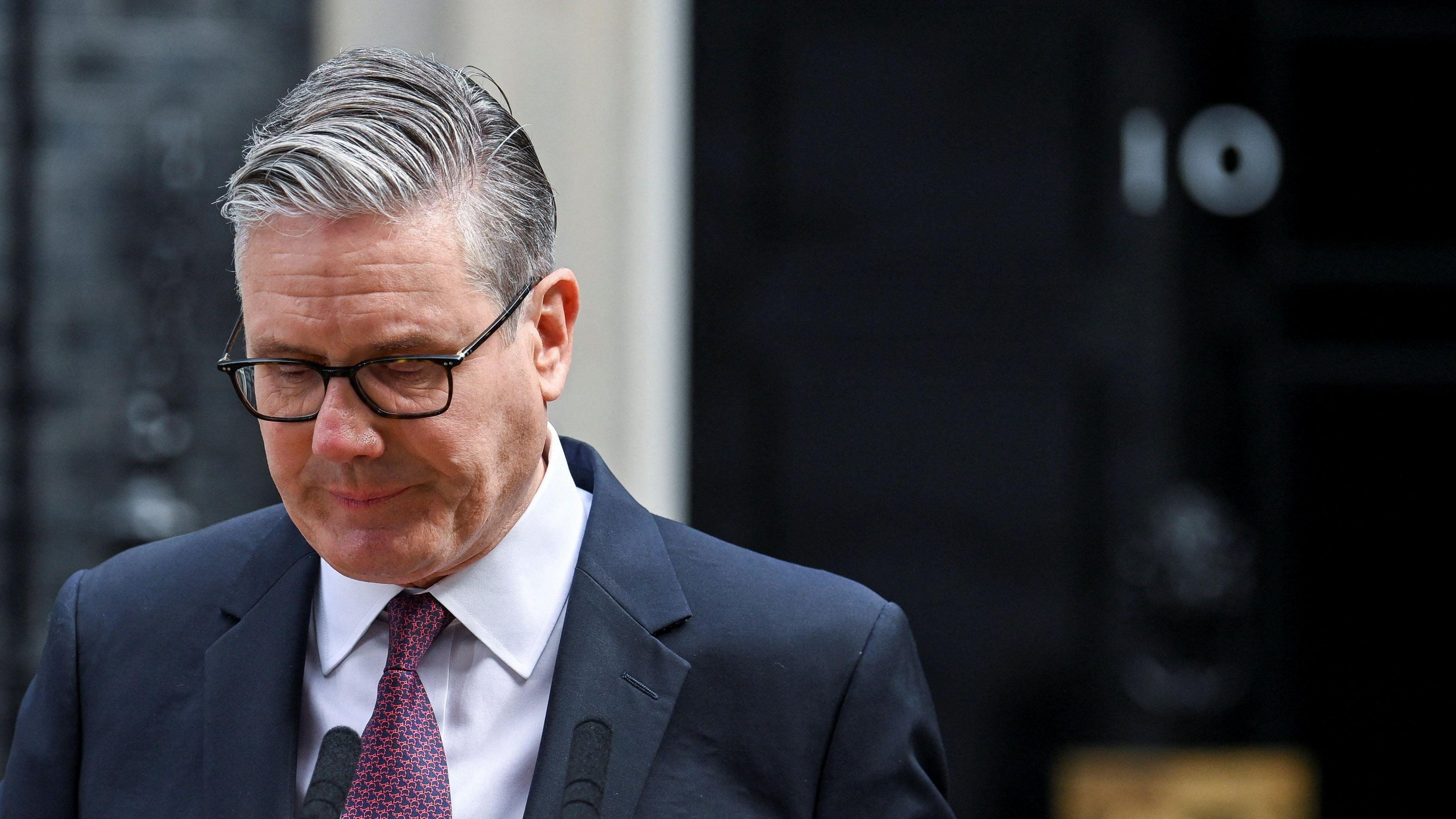
Anyway, that’s nothing to do with what I wanted to write about, which was: how come Sir Keir Starmer’s resignation speech was such a dud? (You can watch it here or read the transcript here.)
After all, Sir Keir was not short on classic rhetorical patterning1. It was one figure after another. There was antithesis — “Not power for power's sake but to change Britain for the better”; “Wealth and opportunity for all, not just the privileged few”. There was syntheton — “disappointment and despair”; “full and unequivocal”; “stronger and fairer”. There were parallel constructions — “Investment secured, infrastructure being built”; “better prepared for the challenges ahead, and better able to ensure…”.
And, of course, things came in threes as nature intended. Here’s a euphonious little tricolon: “politically, financially and morally bankrupt”. That was the Labour Party our man inherited, apparently. You could nitpick over whether the tricolon would have been more crescens had he swapped financially and politically round, the latter being a slightly grander and less accountant-like complaint, and it would maybe prevent that awkward shuttling back and forth between the figurative and literal meanings of bankrupt… but, y’know, with a tricolon it’s all about the sound effect and this one worked fine. There was another rather flatter tricolon: “the economy, defence, and national security.” And another: “decency, respect and the rule of law.” And still another: “Commitment, service and support.”
Sometimes his groups of three even got a bit of figural oomph themselves:
Change promised by a Labour government. Change fought for by a Labour government. Change delivered by a Labour government.
That’s a showy little run of symploce, where you can’t decide between epistrophe (repeating a word at the end) and anaphora (repeating one at the beginning) so you throw caution to the wind and do both. Only for advanced learners. You love to see it.
Yet the whole thing was incredibly humdrum. I think there are two reasons for this.
Sir Keir has a basic grasp of the rhetorical figures, but no real feel for how to apply them. He’s so fond of a couple of them — specifically, ellipsis (where you leave a word out) and zeugma (where a succession of clauses are governed by the same epithet, cf Flanders & Swann “he put out the cat, the wine, his cigar and the lamp” — that he plasters the whole speech with them.
But the thing about a fancy rhetorical device is that its effect is proportionate to the extent it’s disruptive. If it’s the norm, you’re just talking funny.
Nearly the whole first half of the speech — the one where he was defending his record — consists of sentence-fragments wth no main verbs, governed zeugma-style by a previous sentence.
I’ve bolded the sentence-fragments in a couple of the longer runs, and put the governing phrase in italics:
But we proved those people wrong because we changed our party.
Ripping out the poison of antisemitism, restoring trust on the economy, defence, and national security.
And becoming a party that, once again, stood proudly with, not against, our national flag. The hard work of change was with a singular purpose. Not power for power’s sake but to change Britain for the better.
To build a fairer country, with dignity and respect, where everyone is seen, everyone is valued. Wealth and opportunity for all, not just the privileged few.
And then, immediately, he’s at it again
And look at what we’ve achieved in just two years.
An economy that is stronger, growing faster than our peers. Wages rising faster than inflation in every single month since we came to power. Investment secured, infrastructure being built. An end to austerity, with the fastest fall in NHS waiting lists for 17 years.
The biggest improvement in rights for workers and renters in a generation. The biggest uplift in defence spending since the Cold War. Small boat crossings falling, asylum hotels closing, protecting young people from social media, and half a million children being lifted out of poverty because of the choices that I made.
Our reputation in the world restored, with Britain once again standing up for decency, respect and the rule of law. Securing trade deals, standing with Ukraine, standing up for our values, and rebuilding our relationship with our allies in Europe.
Change promised by a Labour government. Change fought for by a Labour government, change delivered by a Labour government.
That’s not a speech. That’s a list.
Sir Keir doesn’t have any sort of flair for phrasemaking. In fact, he has a sort of anti-flair for it: a genius for whatever the opposite of phrasemaking is. But rhetoric, in the end, is all about phrasemaking.
Whatever we think of him as a politician (not much in this case) Boris Johnson’s phrases — “Go back to your constituencies and prepare for breakfast”; “Inverted pyramid of piffle” — have survived in memory for years. Sir Keir’s don’t survive in memory for the duration of the speech.
He talked about “putting the country I love first”. He talked about “the proudest moment of my life”. He talked about a “orderly handover of power”, “children being lifted out of poverty”, “the poison of antisemitism”, “standing up for our values”, “challenges ahead”. He delivered phrase after phrase after phrase that seemed almost purpose-tooled to interact with the heart and memory in the way that neutrinos interact with solid matter.
Where the language wasn’t off-the-peg, it was awkwardly wordy. Fully halfway through, he got to the actual resignation bit. But he reversed into it with this unlovely sausage-string of clauses about the question that was not being, apparently asked: “But I know the question being asked now is not who was best placed to change the Labour Party, to take us into power, and to begin the vital work of improving lives for millions of people.”
And a half-decent ear would have noticed that in his friendly remarks about the help — “I want to thank the brilliant No 10 staff and our country’s extraordinary civil service, who dedicate their lives to public service” — that repetition of “service” just seven words apart delivers a bathetic clunk.
Even where, in his peroration, a crack entered his voice as he paid tribute to his family— the phrase no doubt he’d use — the epithets he chose to describe them in this apparently personal, individual, humanising moment were “a rock by my side” and “my pride and joy”. You know those funeral speeches where the celebrant never met the deceased? Yeah: that.
I think that may have been a lot of his problem. Here was something that was formed a bit like a speech, but didn’t do what speeches are supposed to do. The containers were the right shape at phrase level, but they were empty. And here was a man who looked a bit like a Prime Minister when he came to power, but turned out to be emptier in the role than anyone could have imagined.
When you’re a PM, you’re not just a bureaucrat: you’re a salesman. If you have no gift at all for arresting speech, you have no gift at all for being Prime Minister.
Still, holding the man no ill-will, I’d like to think that he’s now relaxing in a cold bath, somewhere, with a well deserved mint julep.
***
Speaking of holding him no ill-will, I once again made myself popular with the Spec’s BTL commentators by suggesting that their demented loathing for Keir Starmer was, in fact, demented.
***
This week’s Book Club podcast was with Carlo Rovelli, talking about nuclear war, how we’ve avoided it and why he’s worried our luck won’t last.
See you next week!
I make no apologies for being nerdy about this stuff. I even wrote a book about it.
I don't know if the Greeks gave a name to it already, but there is *something* about the fact that the phrase most associated with him will probably go down as being "the release of the sausages".
Excellent. The whole thing had the tone of a funeral oration, and not a good one. It captured rather wonderfully why people just don’t want to have this guy around any more.