
My Back Pages No.1
Reading, rereading, decimating: feat. John Betjeman and Donald Trump

I’ve been toying with a “My Back Pages” slot as a feature for this newsletter. The premise would be to grab a book from the shelves of my library, and maybe post a photograph if it’s interestingly inscribed or marked up, or shows signs of having been eaten by a dog, clawed by a cat or dropped in the bath. The idea occurred to me when I was, as frequently, combing through the shelves in search of a quote, or a specific book to lend to someone, and realising that almost every title whose spine I fingered carried a memory.
I kept, until it became impossible because I’ve been doing this for too long, a copy of every book I have reviewed. There are books that kept me company in university, random books I inherited from my maternal grandfather (signed copy of Alan Shepard1’s memoir, anyone?) or paternal grandmother (The Square Egg and The Chronicles of Clovis by Saki), books I borrowed and failed to return, and the book sent to me as a probable death threat (we’ll get to that in due course). Plus, given my day job, I have a whole bunch of signed copies and proofs, many of them from writers I’ve interviewed. There are stories attached to these books, in other words: why not tell the stories?
A personal library is a sort of transactive memory, a pointillist self-portrait in other people’s words. When the great Francis Spufford titled his memoir The Child That Books Built he wasn’t joking. When I drop off the perch (a prospect that’s no longer as far off as it used to seem), about the only thing I care about in the personal effects department is the disposition of my books. If my children, grown up, want to know who I was outside my roles of finder-of-lost-shoes, maker-of-minestrone and weary-picker-up-of-dogshit, I hope they will read some of what I’ve written; but what I’ve read, and what I’ve chosen to keep, is probably the truer guide.
I think, in this context, of Robert Lowell’s poem “Reading Myself”, in which he writes:
No honeycomb is built without a bee
adding circle to circle, cell to cell,
the wax and honey of a mausoleum–
this round dome proves its maker is alive;
the corpse of the insect lives embalmed in honey,
prays that its perishable work live long
enough for the sweet tooth bear to desecrate–
this open book... my open coffin
Lowell was talking about the books he wrote2 rather than the books he read, but I think the same applies. The sweet tooth bear is coming for us all. Above all. I keep saying: don’t for God’s sake just pack it in boxes and bin it because *some* of these scratty looking proofs will be, for instance, signed by Seamus Heaney or Thom Gunn or James Ellroy and might be worth something, and that signed first edition of the 77 Dream Songs cost me a grand a bit over twenty years ago. (We’ll get onto those, too.)
This is why, I think, I experience my wife’s quite reasonable repeating complaint that I have too many books and should get rid of some of them as personal attacks. These are the dead-tree version of me. Asking me to chuck them out is, like, a microaggression? Every time I am forced to purge them, whether to the charity shop or to another sealed box in the attic, I moan and groan and feel bereft. Every time I discover that I need some long-neglected volume to fish out a quotation I feel a little thrill of vindication: see! It was worth hanging on to. So if I can make something professionally useful out of the process, that might be a sneaky rearguard action; a secondary motive for starting this feature.
The book it feels natural to start with is maybe the first I acquired. The acquisition is unusually easy to date. I have a pale green hardback copy of Summoned by Bells inscribed to me by the author. “To Sam Leith, aged 90 days,” it says in a shaky hand on the fly leaf. “From his and his parents’ great friend and admirer John Betjeman, aged 67 years.” Or, at least, I think that’s what it says though I quote from memory because I can’t lay hands on it. I have – as mentioned -- too many books, and many are double-stacked, and I’ve squirreled some of the more precious ones away in places that, like Pooh with his emergency jars of hunny, I will tend to lose track of.
But talk about once seeing Shelley plain. I once, I fancy, filled my nappy in the presence of Betjeman, and I feel blessed to have done so. I don’t remember the encounter, for obvious reasons, but I do remember the book. It’s among my most precious. And Betjeman was a presence in my household as I grew up. He really was friends with my parents – my dad was an actor then and my mum a fledgling journalist and neither belonged in a very direct way to the so-called literary world, but they met at a lunch thrown by my newspaper editor grandfather and became fast friends.
To hear them tell it they used to ferry “McBetjie”, as they called him, back home to Smithfield from their flat in Westbourne Grove in the old-school Volkswagen camper van they had when I was tiny. Betjeman called it “The Floating Drawing-Room” and would give them urgent and imperious directions before peeping through the windscreen, excitedly pointing upwards at this or that architectural marvel — an unusual angle on St Paul’s, say — as they passed through London’s streets in it.
In their record collection (younger readers: records were these weird black plastic discs that made sound when you put them on an old-fashioned contraption) were at least two of those wonderful discs of Betjeman reading his poems to Jim Parker’s music: Banana Blush, with its blue, yellow and pink colour scheme; and Late Flowering Love, with the poems printed on the sleeve. I especially adored “The Licorice Fields at Pontefract”, with its gloriously urgent brass: melancholy and uplifting all at the same time.
Betjeman was a seriously good poet, I think, underestimated in his own lifetime. He was too popular to earn anything but grudging approval from the critics, and his use of form a bit too trad. Plus, being able to be funny usually marks you down; as does becoming Poet Laureate. But he had a great ear, and he wasn’t — pace his funny squib about Slough, the excellently spiky payoff of his “Varsity Rag”, and those lolloping poems about robustly-put-together county gels “furnished and burnished by Aldershot sun” – by any means restricted to light verse. There was a deep plangency in his work. He was no less alive than Housman to the blue remembered hills, or than Victoria Wood to the melancholy bathos of modernity. Betjeman once said in an interview that the theme of all his poetry was: “You’re all alone, you fall in love, you’ve got to die.”3 My dad could recite “A Child Ill” from memory, but never without his voice cracking: “Oh little body do not die.”
Betjeman been a mental presence for me lifelong. He was heavy and light at the same time. I like that when he was asked late in his life about his regrets, he said: “I haven’t had enough sex.” As with Larkin’s glum lines on the subject, this was a bit disingenuous: Betjeman’s extramarital carryings-on were well known even in his lifetime, and he seems to have had his fair share of sex. Maybe nobody’s fair share seems fair. Or maybe he was just being funny. Or maybe, as often, he was being funny about something he felt seriously about.
When the one-volume version of Bevis Hillier’s biography came out at the same time as A N Wilson’s, I reviewed them together for the Spectator. (Tricky commission, that: the two men loathed each-other, and Hillier — as was about to become clear — had played a funny but humiliating prank on Wilson, a sort of unexploded bomb planted in his manuscript.) Rereading that now, I think I got it about right. He was a more complicated and a more tormented man than the public image of “the Nation’s teddy-bear” that he settled into.
On the wall of my mother’s sitting-room there still hangs a big framed photograph of Betjeman in late life, standing windswept in a sunny field, gloriously endowed of tum and roaring with laughter. Printed beside him is his late poem: “The Last Laugh.”
I made hay while the sun shone.
My work sold.
Now, if the harvest is over
And the world cold,
Give me the bonus of laughter
As I lose hold.
Words to live, or maybe to die, by.
***
Pedantry klaxon. Donald Trump announced that the US and Israel had “beaten and completely decimated Iran both Militarily, Economically and in every other way”. I felt a great disturbance in the Force, as if a million readers of the Daily Telegraph suddenly cried out. The origins of the word “decimate”, as proud pedants like to point out, are in disciplinary measures taken against suboptimal Roman legions: it means you’ve killed one man in ten as a punishment. Decimate, technically, means reducing something by a tenth, then. (In which case “completely” is a bit redundant.) Me, I think we can be relaxed about it. It’s not as if we really need to reserve the word for its original use, given that there aren’t that many Roman legions knocking around these days and decimation has gone out of fashion as a disciplinary measure. It has come to mean “obliterate”, and Tunbridge Wells will just have to put up with it. Using “both” of more than two things, OTOH…
***
On a cheerier note, the springing of Spring is at last underway. That, plus the fact that I made it through an airport last week without having a pint4, has put me in a rare good mood. Here’s5 the forsythia in my garden, which always heralds the change of season, showing its approval.
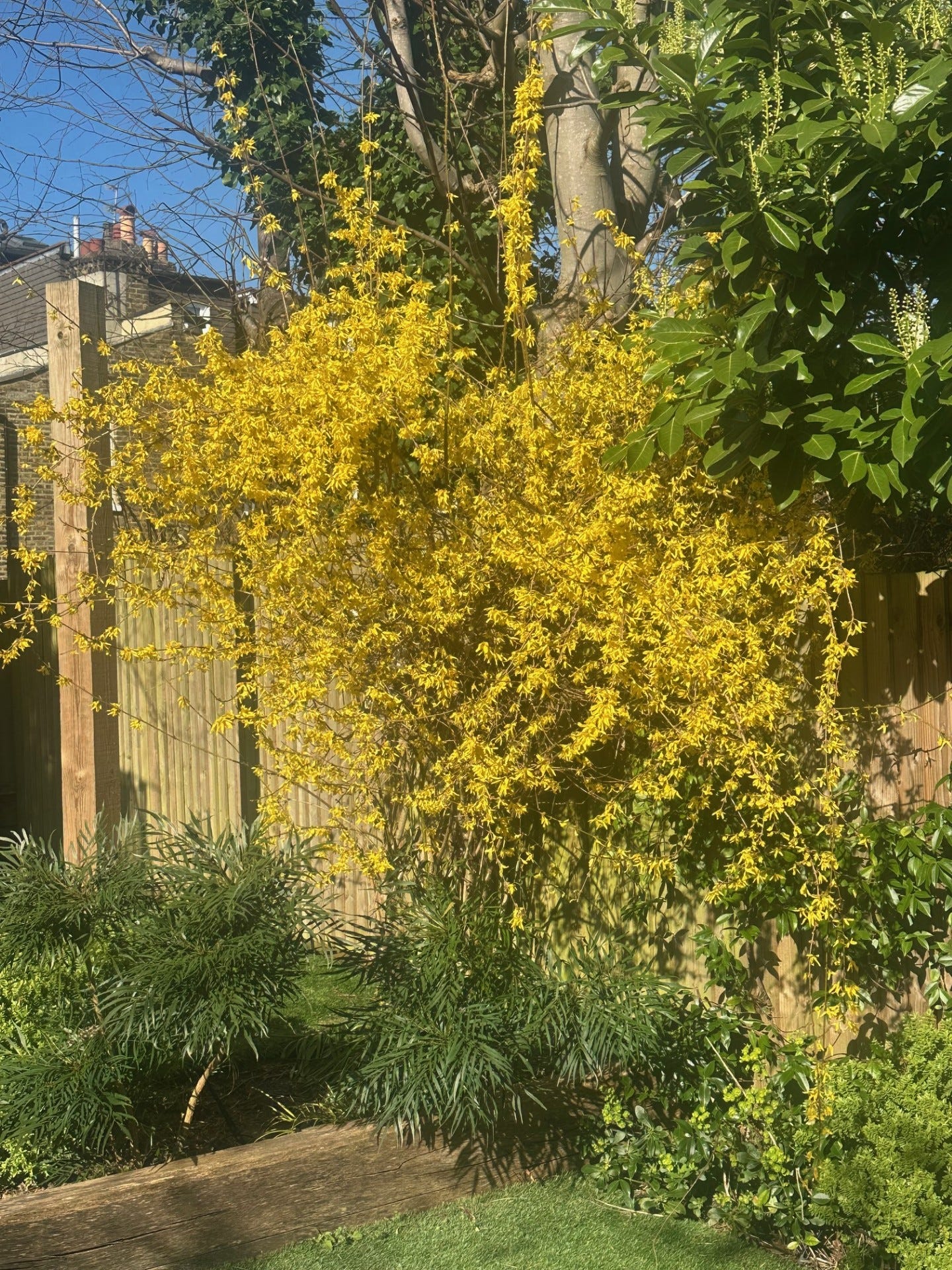
I like forsythia. So here’s a Veruca Salt song about it too. Volume up, as the kids say.
***
This week’s Book Club podcast was with Howard Jacobson, talking about his new novel Howl, in which he vents his rage and bafflement at the liberal reaction to the October 7th massacre. Given that the first thing we learn about that novel’s protagonist is that he “has a fall” (as they say of people past a certain age) on a London street, Howard showing up to our recording session with a bandaged hand, black eyes and a scuffed nose showed considerable commitment to the bit. He mentions it briefly at the end of our conversation. He’s great, I think, on why humour is not just possible but vital at the darkest times.
***
My column for the Spectator was in praise of Richard Tice’s tax arrangements. I gather from a colleague that Mr Tice himself got in touch to say he found it funny, which I count as a bit of a failure. I guess that’s what they call “repressive tolerance”.
***
I mentioned the other week my British Library event with Philip Pullman and Julia Eccleshare on the 27th. It is now, alas, sold out. But you can still book to watch it online with the link in this par.
***
Other news? I spent this morning interviewing the classicist Daisy Dunn about her life and work for Axess TV. She had really interesting things to say about how she approaches the classics, the split in the subject, the derr-brained tech-bro fetish (my words, not hers, I should say) for Marcus Aurelius and Sparta, walking the line between relatability and alterity, and what’s so great about Ovid. I’ll post that when it’s up.
Alan Shepard was a particular hero for my late grandfather because he was the first man to hit a golf ball on the moon.
I have, somewhere, a cassette tape of Lowell giving a reading in which he reads this poem and grumbles (in that magnificently weary Boston brahmin voice) that some critics took him too literally when he wrote that he “somehow never wrote something to go back to”, and agreed that they couldn’t find much to go back to either. Big laugh. He’s also very funny about “Skunk Hour” in the same recording. Noting that Richard Wilbur thought the skunks in the poem were “furry little emanations of nature” while John Berryman called them “a catatonic vision of frozen terror”, he said, after a beat pause: “That’s the advantage of writing in an ambiguous style.” I do recommend listening to Lowell read his own work. To me, the voice makes a lot of sense of the poems, especially thae short lines in his last book Day by Day. Gah, but, again, Lowell is someone we’ll get on to in due course.
It’s the theme to pretty much everything, if you ask me.
Airports are huge triggers because they’re full of pubs, nobody knows you and it’s completely acceptable to tie one on at 6am.
This is my first attempt at putting a photo in a Substack, so if it doesn’t work sorry.
Is he killing time? Out on the street
two cops on horseback clop through the April rain
to check the parking meter violations—
their oilskins yellow as forsythia. - Robert Lowell (The Drinker)
More about your relationship with books would be wonderful, thanks. I'm also curious to know the process behind your ability to find quotes from old books. That feels like magic in a world of AI and epubs.