
What Orwell Got Wrong About Language
Writing: feat Georges Orwell and Weidenfeld, wise words from T S Eliot and the chance to tease my old friend Simon Heffer

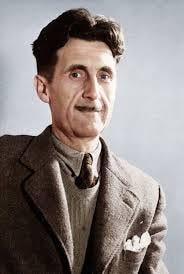
There’s a particular species of bore — as likely, oddly, to be on the right as on the left these days — who treats George Orwell as an unquestionable authority on language. “Donkey George”, as the Paget sisters called him when he was trailing around behind them thirstily, has become the Abraham Lincoln of writing advice.
I think it’s time we took him off his pedestal a little, and looked him in the eye.
Orwell is influential as a rules-for-writing guy for two reasons, which should be acknowledged. The first is that he was an accomplished stylist himself. The second is that, unlike many other writers on style, he has a real-world moral and political point to make rather than a generalised harrumph about “correct English”. In his essay “Politics and the English Language” Orwell set out an argument about the causes and effects of bad writing — with particular attention to political euphemism — and a six-point plan1 for fixing it.
Supplying a handful of examples of clumsy writing, he identifies in them two common qualities: “The first is staleness of imagery; the other is lack of precision.” Orwell considered the plain style a moral as well as a political virtue: it was essential to the proper workings of democracy that people understood what their politicians were actually saying. The obfuscations of official language, he said in a much-quoted line, were often purposely designed “to make lies sound truthful and murder respectable, and to give an appearance of solidity to pure wind”.
We could say, a bit more sympathetically, that a lot of muddy and pompous writing does not set out to make murder respectable. The stakes are a bit lower. A lot of management bollocks, academic arcana and pompous officialese comes to be as it is not because it intends to deceive its intended audience, but because it loses sight of it. To repeat a point I’ve made in a previous post about ethos and phatic communication, it’s a sort of herd-writing.
Anyway, Orwell’s six rules, quite detached from their political context, are still very often cited by modern style guides. This, in itself, is an odd thing. The essay was first published in 19462. That’s eighty years ago. Had Orwell made the lodestar of his advice on style, say, Matthew Arnold – whose Culture and Anarchy came out about seven decades before “Politics and the English Language” – he’d have looked a little peculiar.
If change is a fundamental fact of language itself, we should be wary of the natural instinct to respect an authority in accordance with its long standing. But Orwell is a big figure in the landscape. And because many of his statements are general enough to endure, and because many of them are still useful, he bears engaging with.
So: the Six Rules.
Never use a metaphor, simile or other figure of speech which you are used to seeing in print
Here is the familiar injunction to avoid cliché3. I’d want to put in a word for cliché. “Dog-tired” is a cliché – but it’s also a perfectly useful, and slightly more colourful, synonym for exhausted.
Orwell’s objection is that the cliché is a pre-packaged unit of ready-made thought – he complains early in the essay about prose consisting “less and less of words chosen for the sake of their meaning, and more and more of phrases tacked together like the sections of a prefabricated hen-house”. He’s right. We should be doing our own thinking.
But the very fact that they are pre-packaged units of thought means that some clichés — like familiar words or phrases themselves — are a very quick means of delivering that thought with a minimum of effort. When you talk about a “dog bites man” story, say, or “the thin end of the wedge” everyone knows instantly what you mean. So clichés have their use. In a sense every word we speak is a cliché: we wouldn’t be able to understand it if it weren’t.
It may be worth distinguishing between the cliché as delivery mechanism for an idea and the cliché as supposed ornament to the prose. Think about your clichés, in other words. If a qualifier flocks unthinkingly with a noun – you can’t mention a lesson, for instance, without appending the word “salutary” – you’d do well to dispense with it. That’s a cliché of pomposity. It sounds rather grander than just saying “lesson”. “Salutary”, there, functions more as an empty intensifier than a word hoping to convey a specific meaning.
The aim of a metaphor or simile is, usually, to bring something freshly before the mind’s eye: if your metaphor is off-the-peg4, by definition it fails to be fresh and lively. Saying something was as “dark as pitch” or as “hot as hell” gives us no fresh sense of the darkness or the hotness. Neither author nor reader is picturing either pitch or hell.
Metaphors so established that you don’t register them as images generate an additional risk. The author may start combining these set phrases unthinkingly, and end up with a mixed metaphor: “The explosive pivot which was to seal his fate arrived that afternoon.” At that point the reader will stop dozing — jolted awake by the unexpected juxtaposition of set phrases — and start trying to picture the images referred to. And when he or she tries to imagine sealing something with an explosive pivot, he or she will start laughing.
But saying, as Joel Morris and Jason Hazeley do in The Ladybird Book of the Hangover (2015), that after a night out drinking Ron has “a head like a smelting works full of howler monkeys on ephedrine” freshens things up no end.
2. Never use a long word where a short one will do
This, again, is usually worth thinking about. More often than not shorter words (and, for that matter, shorter sentences) make the reader’s life easier. But there is nothing intrinsically easy about short words or intrinsically difficult about long ones. There are short words that are quite abstruse — “tmesis” or “gluon”, for instance — and long ones that are quite ordinary, such as “accommodation”, “mountaineering” and “xylophone”. It’s comprehensible you’re after: not short as an end in itself.
If it is possible to cut a word out, always cut it out.
As others have pointed out here, he could have written: “If it is possible to cut a word, cut it.” Or even: “If you can cut a word, do.” Followed automatically, this is a mandate for a monotonously telegraphic style. Concision and directness are virtues, but minimalism isn’t the only route to clarity. Good writing captures a voice — and humans don’t speak like robots. Better advice would be less categorical. If it is possible to cut a word out, always think about cutting it out.
Never use the passive when you can use the active
This is the dodgiest of all Orwell’s rules, and the anti-Orwell camp5 has lots of fun with it. Prejudice against the passive – often associated with the idea that active forms are “muscular”, “dynamic” or “sexily rapey”6 – has been a feature of style advice since long before Orwell. And most of those who attack it use the passive voice plenty.
Orwell’s essay, as I’m not the first to notice, begins: “Most people who bother with the matter at all would admit that the English language is in a bad way, but it is generally assumed that we cannot by conscious action do anything about it.” “It is generally assumed” is, as any fule kno, a passive construction. Orwell, whatever he might have professed, was addicted to them. Merriam Webster’s Dictionary of English Usage took a certain pleasure in pointing out: “Bryant 1962 reports three statistical studies of passive versus active sentences in various periodicals; the highest incidence of passive constructions was 13 percent. Orwell runs to a little over 20 percent in ‘Politics and the English Language.’”7
The passive voice is useful. “A man was shot” is clearer and more concise, in the absence of the aggressor’s identity, than “someone shot a man”. Also, it changes the emphasis to write the latter. Our concern is with the dead dude, so he comes first.
But again — to break his rule number one — there’s a grain of truth8 in it. By and large9 active verbs feel more decisive and energetic. Just as when it comes to the long and short distinction, or the pruning of superfluous words, here is — taken a bit more loosely — the sensible advice to pay attention to whether you should be using an active or a passive construction. A presumption for the former, all other things being equal, will serve you well. It will also bring you into line with the language as a whole.
Never use a foreign phrase, a scientific word, or a jargon word if you can think of an everyday English equivalent
Well, again, yup. We’ve all felt that sense of ennui when we’re subjected to some pompous twerp’s bons mots in another language. But the overtones of linguistic nationalism in that are pretty unattractive. English wouldn’t be English if people hadn’t been breaking Orwell’s rule since before the Norman conquest. Loan-words and appropriations are the main wellspring of linguistic change. Where would we be without Schadenfreude or esprit de l’escalier – two foreign words with no concise English equivalents?
Where it makes sense is not in its misleading emphasis on “English” as against “foreign” – which has its issue in the boneheaded injunctions of several writers on style to prefer Anglo-Saxon-derived terms to Latinate ones. It’s in the word “everyday”: the wider the number of readers you hope to reach with your piece of writing, the more you will want to lean on commonly understood terms.
These “everyday” terms may indeed often be Anglo-Saxon in origin: those words are buried closer to the bottom of the word-hoard, and are often less (Latinate) polysyllabic or (English) wordy. But to select them on the grounds of their origins, rather than the place they occupy in our common vocabulary now, is to get things backwards.
There’s a tension, too, implicit in this advice. But virtue of their everydayness, common words usually have a wider range of meanings; they are, taken in isolation, less precise. What makes them precise is their place in the sentence. We know that “dog” might signify a sausage in a bun, a woofing quadruped, a promiscuous man, a bad movie, or any number of other things. In the right place in the right sentence, it will mean only one of them to any competent reader of English.
TS Eliot’s description in “Little Gidding” of “every phrase/ And sentence that is right” more or less nails10 this: “where every word is at home,/ Taking its place to support the others,/ The word neither diffident nor ostentatious,/ An easy commerce of the old and the new,/ The common word exact without vulgarity,/ The formal word precise but not pedantic,/ The complete consort dancing together...”
So, again: you’re looking for the right word — the word that will be most widely and swiftly understood to carry the meaning you intend — not necessarily the English one.
Break any of these rules sooner than say something outright barbarous
And here’s the nub of it all. Leave aside that “barbarous” is a word that tends to a circular definition or no definition at all: the first half of that sentence is the bit that matters. Because language is always situation-specific and audience-specific, the more general and absolute the rule of usage you champion, the more likely it is to be useless.
Orwell’s preceding five rules, then, should not be taken as rules at all. They are often sound as guidelines, but they should be pointers to issues to think about. Does the long word or the short one work better? Is your jargon strictly necessary? Is the active or the passive voice better suited to this construction?
We can, in other words, acknowledge the usefulness of Orwell’s advice without regarding it as holy writ.
TLDR: Rule Six is the only important one, and only really the first half of Rule Six, at that.
***
This week’s Spectator column was a jab at the way big tech is rejigging the idea of what it means to own something. This touches on the stuff Cory Doctorow has been banging on about for ages with much deeper knowledge and in more detail than me, so I urge his work on you.
***
This week’s Book Club podcast was with Andrea Wulf, talking about her fantastic new book The Traveller: The Revolutionary Life of George Forster and his Search for Humanity.
***
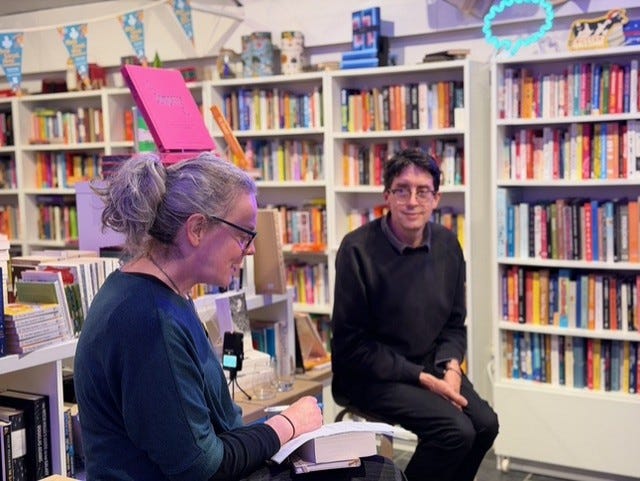
As promised, here’s the audio of my conversation about children’s literature with Liz Garner at the wonderful Caper Bookshop in Oxford.
***
And I reviewed Melissa Albert’s first novel for grown-ups, The Children, for the Guardian.
He was ahead of the game on this listicle thing. Got to give him that.
A digression. It might have been published sooner. Before his death in 2016 I had the good fortune to meet George Weidenfeld, who had worked with Orwell in the BBC’s propaganda department during the war. “What was Orwell like?” I asked him. He made a face. They’d had a slightly awkward relationship, he said, because Orwell was annoyed that George had turned down one of his essays for publication. “Which essay?” I asked. “Politics and the English Language,” said George, cheerfully.
“Avoid clichés like the plague!” chimes in the saloon bar wag; shortly before a stout length of four-by-two connects with his chin.
“Off-the-peg” here is a cliché. It’s not designed to bring gentlemen’s suiting to your mind’s eye, though; rather, to deliver in three monosyllables the notion of something that has been pre-measured and mass-produced.
Which includes luminaries such as the Professor Stanley Fish, who inveighed against “what is surely the most overrated essay in the modern canon, George Orwell’s turgid, self-righteous and philosophically hopeless ‘Politics and the English language’”, and the linguist Geoffrey Pullum, who agreed: “I despise that essay of Orwell’s.”
I made that one up, but there’s a definite and distinctly suspect gendering to the way in which passive forms are denigrated.
Another teachable moment. A lot of those who issue stern edicts about style are ignorant of their own practice. A single page from Simon Heffer’s Simply English, in which he thundered against redundant words (in line with Orwell’s rule number three), was red-pencilled by a well-wisher to remove no fewer than 59 redundant words. An image of the corrected text still pings around the Internet to this day.
***UPDATE*** The man in question just replied to this post on Bluesky and supplied an image of his glorious Heffer-troll. Here it is. Chapeau, as Orwell wouldn’t say, to Tom Freeman.
Another dead metaphor
See Rule Three, Leith, you idiot
Another dead metaphor
I study sixteenth- and seventeenth-century prose, which I find all the richer because those writers did not observe the kinds of strictures George Orwell advocates. I'm trying to imagine what Sir Thomas Browne would have said if someone told him not to insert liberal doses of Latin into his writing or pile up synonymous clauses in a biblical manner.
I don't take unkindly to these 6 points though i think orwell overstated his case to the point of almost deeming pretentious anything that smacked of density. Storm jameson distrusted abstractions too. There is a case for clarity and lucidity . But i believe readers can generally intuitively see where something adds richness in prose and where there is pretension. Since reality is complex language would reflect that . But certain terms have a flavor too - comme il faut, acte gratuit aren't just stylistic but carry a certain unmistakable resonance and may seem appropriate . I also think that with orwell these six pointers are connected to his political and moral perspective too which had certainly its bravery and insight but also complicated attitudes towards the british empire, india etc. I also think perhaps orwell was responding in part to the bloomsbury aestheticism and in that he wasn't alone. A lot of middlebrow writers like margery sharp , e.h young , storm jameson distrusted vapid sophistication. Orwell's backhanded praise of wyndham lewis always amused me given wyndham lewis had a pretty complex linguistic register. Ultimately i feel with orwell , as with kafka, there is an oversaturation in the field of cultural dialogue with terms like orwellian , doublespeak etc which get abundantly used . Directness in prose can often be undervalued and a certain decorative flair be seen as more nuanced than it is. It really comes down to the relationship between language and experience . Good rich prose can be relished if the experience has concomitant depth. But the problem today is, with decades of humanities degrees and absorption of a sheen of linguistic layering we have become over cultured and mannered. Even our spontaneity seems contrived . My own instinct is to be sympathetic to orwell's strictures but with a whole bunch of rebuttals and misgivings. As an aside i think preoccupation with language over reality is why writers fear LLM'S and AI because it shows us up as linguistically adroit than experientially wise. And wordiness can only go so far.